
Accessible Information Requirements Are Changing Rail Replacement Operations
For many years, rail replacement services have focused on one core objective: moving passengers safely and efficiently when rail services are disrupted. Whether supporting planned engineering works, emergency line closures, or major events, operators have become experts at deploying vehicles and drivers at short notice.
However, a significant change is now reshaping the rail replacement landscape.
The Public Service Vehicles Accessible Information Regulations (PSVAIR) require operators to provide accessible onboard passenger information through both audible and visible channels. While accessibility has long been recognised as an important aspect of passenger transport, the regulations create a formal obligation to ensure passengers can independently access information about their journey.
For rail replacement operators, this presents a unique challenge.
Unlike traditional bus services, rail replacement fleets are often temporary, highly flexible and made up of vehicles from multiple operators, depots and subcontractors. Solutions that work well on permanently allocated bus fleets may not be practical for vehicles that are reassigned daily or deployed at short notice.
This article explores what operators should be considering as accessible information requirements become an increasingly important part of rail replacement operations.
What Is PSVAIR?
The Public Service Vehicles Accessible Information Regulations were introduced to improve the travel experience of passengers who may otherwise struggle to access important journey information.
The regulations require passengers to be provided with key information in both visual and audible formats, helping support:
Passengers with visual impairments
Passengers with hearing impairments
Visitors unfamiliar with an area
Occasional public transport users
Passengers travelling in unfamiliar environments
The underlying principle is straightforward: passengers should be able to understand where they are, where they are going and what is happening during their journey without needing to rely on other passengers or the driver.
In practical terms, this means providing information such as:
The next stop
The final destination
Significant diversions
Service disruptions
Interchange opportunities where appropriate
Why Rail Replacement Is Different
For many fixed-route bus operators, compliance can be achieved through permanent onboard audio-visual systems installed into vehicles.
Rail replacement operations are different.
A typical rail replacement fleet may include:
Vehicles from multiple operators
Temporary subcontractor vehicles
Hired coaches
Vehicles assigned to different work on different days
Emergency deployments with limited notice
A vehicle used on a rail replacement contract one weekend may be operating school services or private hire work the following week.
This flexibility creates challenges when considering traditional onboard passenger information systems.
Operators often face questions such as:
Is it practical to permanently install equipment into every vehicle?
How can accessibility requirements be met across subcontracted fleets?
What happens when additional vehicles are required at short notice?
How can compliance be maintained without extensive engineering work?
These are becoming increasingly important operational considerations.
The Challenge of Fixed Vehicle Installations
Traditional onboard passenger information systems have historically been designed around permanently allocated fleets.
While these systems can be highly effective, they often require:
Vehicle modifications
Dedicated hardware installation
Workshop time
Ongoing maintenance
Vehicle-specific configuration
For operators running dedicated service fleets, this may be entirely appropriate.
For rail replacement operations, however, flexibility is often just as important as functionality.
A solution that takes days to install may not be suitable when vehicles need to be deployed quickly or reassigned regularly.
This is why many operators are beginning to explore more portable approaches to accessible information.
Portable Passenger Information: A New Approach
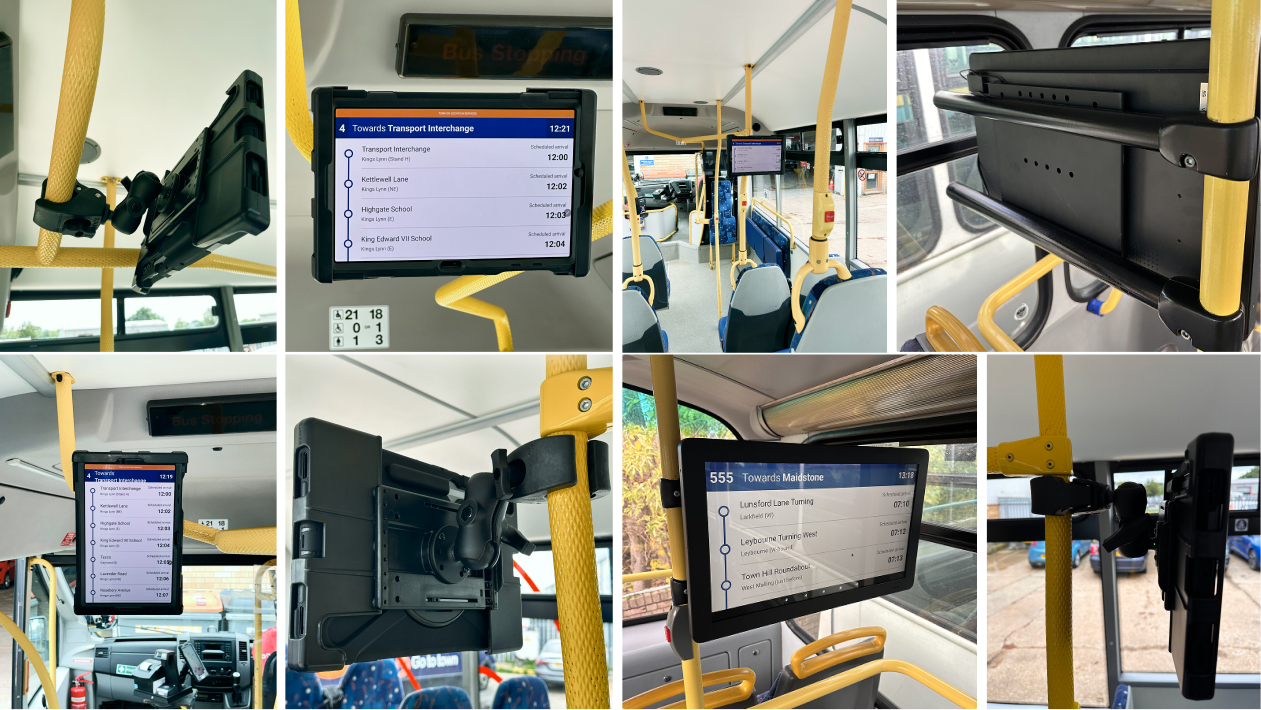
Recent developments in mobile technology have created opportunities to rethink how accessible information can be delivered onboard vehicles.
Modern Android-based devices now provide:
High-resolution displays
Integrated GNSS positioning
4G connectivity
Cloud-based management
Text-to-speech capabilities
Real-time software updates
Combined with intelligent journey tracking and route management software, these devices can provide many of the benefits traditionally associated with fixed installations while offering significantly greater operational flexibility.
For rail replacement operators, portable systems can offer several advantages:
Rapid Deployment
Equipment can be installed in minutes rather than days.
Fleet Flexibility
Devices can move between vehicles as operational requirements change.
Reduced Engineering Requirements
Many solutions can be deployed without vehicle modifications or specialist workshop visits.
Emergency Preparedness
Additional vehicles can be equipped quickly during service disruptions or unexpected demand.
Lower Barriers to Adoption
Operators can begin with smaller deployments and scale as requirements evolve.
Accessibility Should Be More Than Compliance
While regulatory compliance is an important driver, the broader objective should always be improving the passenger experience.
Passengers using rail replacement services are often already experiencing disruption.
They may be:
Travelling at unfamiliar times
Using unfamiliar routes
Boarding temporary replacement services
Navigating station transfers
Clear, consistent and accessible information helps reduce uncertainty and improves confidence throughout the journey.
Passengers who know where they are and what is happening are more likely to have a positive experience, even when their journey has been disrupted.
This benefits passengers, operators and rail partners alike.
What Operators Should Be Considering Now
As accessible information requirements continue to evolve, operators should begin evaluating how they intend to deliver passenger information across their rail replacement operations.
Key questions include:
How flexible is the solution?
Can it be deployed across multiple vehicle types?
How quickly can it be installed?
Will vehicles need to be removed from service?
Can it support emergency operations?
How easily can additional vehicles be equipped?
How is audio delivered?
Does the solution support:
Internal device speakers
External speakers
Existing coach PA systems
Hearing loop integration
How is content managed?
Can routes, announcements and service information be updated centrally?
Does the solution support future growth?
Will it scale as operational requirements increase?
The answers to these questions will differ between operators, but flexibility is likely to become an increasingly important consideration.
The Future of Accessible Rail Replacement Services
Accessible information is rapidly becoming an expected part of the passenger experience across all modes of public transport.
For rail replacement operators, the challenge is not simply meeting regulatory requirements but doing so in a way that aligns with the realities of a flexible, dynamic operation.
Technology is creating new opportunities to deliver accessible information without the constraints traditionally associated with fixed vehicle installations.
Portable, cloud-managed systems now allow operators to provide consistent passenger information across a wide range of vehicles while maintaining the flexibility rail replacement operations depend upon.
About NextStop AIR
NextStop AIR is RiseDM’s Android-based accessible passenger information platform designed specifically for flexible transport operations, including rail replacement services.
The platform supports:
Audible and visual passenger information
Real-time journey tracking
Portable and fixed hardware deployments
External speaker integration
Coach PA integration
Hearing loop compatibility
Cloud-based management and monitoring
As a hardware-agnostic platform, NextStop AIR can operate across a range of approved Android devices and onboard display solutions, allowing operators to choose the deployment model that best suits their operation.
RiseDM is currently preparing for pilot deployments with UK operators ahead of wider availability in June 2026.
To learn more about NextStop AIR or discuss accessible information requirements for rail replacement operations, contact the RiseDM team.
