
Rail Replacement Has Always Been Built Around Flexibility
Rail replacement operations are unlike almost any other form of passenger transport.
Vehicles may be allocated with only a few days’ notice. Additional coaches may be required during major engineering possessions. Subcontractors may be brought in to support larger contracts. Emergency rail replacement services can be mobilised within hours following infrastructure failures or incidents.
This flexibility has always been one of the industry’s greatest strengths.
However, as accessibility requirements become increasingly important, operators face a new challenge:
How do you provide consistent, accessible passenger information across a fleet that may change every day?
For many operators, portable passenger information systems are emerging as the answer.
The Traditional Approach
Historically, onboard audio-visual systems have been designed around permanently allocated fleets.
A vehicle would typically be fitted with:
Fixed displays
Dedicated audio equipment
Vehicle wiring
Control units
Integrated passenger information hardware
For urban bus networks and dedicated service fleets, this approach remains highly effective.
The challenge arises when those same systems are applied to rail replacement operations.
A rail replacement vehicle may:
Spend one weekend on engineering works
Return to private hire duties the following week
Operate school contracts during the day
Support emergency rail replacement services at short notice
In these environments, permanent installation can create operational and financial challenges.
The Problem With Fixed Infrastructure
Traditional AV systems often assume that vehicles will remain on the same operation for years.
Rail replacement rarely works that way.
Operators frequently encounter situations where:
Vehicles Change Regularly
Additional vehicles may be required during periods of increased demand.
Mixed Fleets Are Common
Rail replacement contracts often involve multiple vehicle types and subcontractors.
Workshop Capacity Is Limited
Engineering teams already support critical fleet maintenance requirements.
Emergency Deployment Is Essential
Operators may need additional compliant vehicles immediately.
In these situations, permanently installed technology can reduce operational flexibility.
Accessibility Requirements Are Accelerating Change
The introduction of accessible information requirements has forced many operators to rethink how onboard information is delivered.
Passengers increasingly expect:
Audible announcements
Visual next stop information
Destination displays
Service updates
Consistent journey information
Meeting these expectations across a constantly changing fleet requires a different approach.
Rather than viewing accessibility as a vehicle-specific challenge, many operators are beginning to view it as an operational capability.
This shift in thinking is driving interest in portable passenger information systems.
What Is A Portable Passenger Information System?
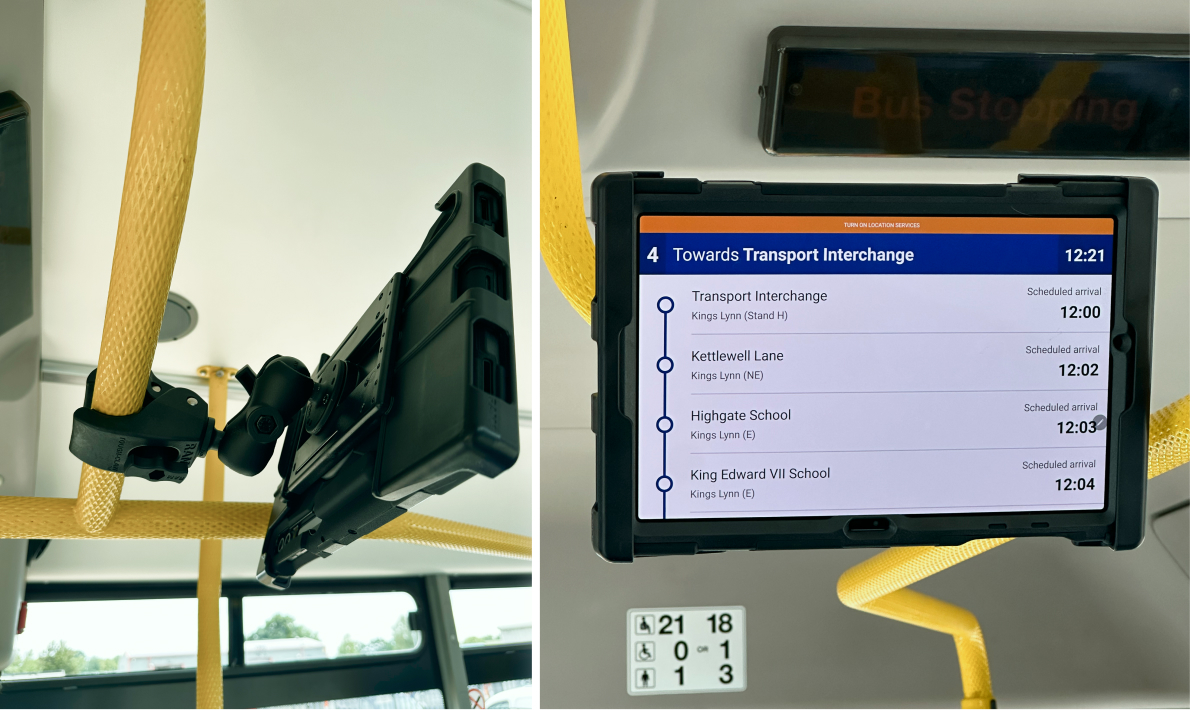
A portable passenger information system delivers many of the same benefits as traditional onboard AV technology but without requiring permanent installation.
Modern systems typically combine:
High-resolution displays
Integrated GPS positioning
Cloud-managed software
Mobile connectivity
Text-to-speech technology
Real-time service information
Mounted securely within the vehicle, these systems can automatically deliver:
Next stop announcements
Destination information
Route progress updates
Service alerts
Diversion messaging
Because the system is not permanently tied to a specific vehicle, it can be transferred between vehicles as operational requirements change.
Why Rail Replacement Operators Are Adopting Portable Solutions
Faster Deployment
Perhaps the biggest advantage is speed.
Portable systems can often be deployed in minutes rather than requiring workshop installation and vehicle downtime.
This is particularly valuable during:
Emergency rail replacement operations
Additional vehicle deployments
Seasonal demand increases
Major engineering possessions
Greater Fleet Flexibility
A single device can potentially support multiple vehicles over the course of a day, week or operating cycle.
This allows operators to:
Maximise equipment utilisation
Reduce hardware requirements
Support mixed fleets
Equip subcontracted vehicles
Flexibility remains one of the most valuable assets in rail replacement operations.
Lower Implementation Costs
Permanent installations often require:
Vehicle surveys
Wiring
Fabrication
Installation labour
Ongoing maintenance
Portable solutions can significantly reduce these requirements.
For many operators, this creates a more scalable path towards accessible information deployment.
Simpler Fleet Expansion
When additional vehicles are required, portable systems can be transferred or deployed rapidly.
There is no need to wait for engineering schedules or specialist installations.
This can be particularly important during:
Planned engineering works
Seasonal travel peaks
Major events
Emergency service disruption
Accessibility Benefits Beyond Compliance
While regulations are often the catalyst for change, the benefits extend beyond compliance.
Accessible passenger information improves the experience for:
Passengers with visual impairments
Passengers with hearing impairments
Elderly passengers
Visitors unfamiliar with an area
Occasional rail users
Clear information reduces uncertainty and helps passengers travel more confidently.
This is especially important during rail replacement operations, where passengers are already navigating an unexpected change to their journey.
What Should Operators Look For?
Not all portable passenger information systems are the same.
When evaluating solutions, operators should consider several key factors.
Audio Flexibility
Can the system support:
Integrated speakers
External speakers
Existing coach PA systems
Hearing loop integration
Route Management
Can routes and announcements be managed centrally?
Real-Time Tracking
Does the platform automatically understand where the vehicle is on the journey?
Operational Visibility
Can operators monitor devices remotely?
Hardware Flexibility
Can the platform operate across multiple approved device types?
Ease Of Deployment
How quickly can a vehicle be equipped and ready for service?
These factors often have a greater impact on long-term success than the hardware itself.
The Future Is Flexible
The rail replacement industry has always evolved to meet changing operational requirements.
Accessible information is the latest challenge, but it also presents an opportunity.
Portable passenger information systems allow operators to deliver a more consistent and accessible passenger experience while preserving the flexibility that rail replacement operations depend upon.
Rather than treating accessibility as a fixed vehicle installation challenge, operators can now approach it as a scalable operational capability.
As the industry continues to adapt, flexible technology is likely to play an increasingly important role in supporting compliant, efficient and passenger-focused rail replacement services.
About NextStop AIR
NextStop AIR is RiseDM’s Android-based accessible passenger information platform designed for buses, coaches and rail replacement operations.
The platform provides:
Audible and visual passenger information
Portable and fixed deployment options
Real-time vehicle tracking
External speaker integration
Coach PA integration
Hearing loop compatibility
Cloud-based monitoring and management
Because NextStop AIR is hardware agnostic, operators can deploy the platform across a range of approved Android devices and onboard display solutions, helping future-proof investment while maintaining operational flexibility.
Pilot deployments are currently being prepared with UK operators ahead of wider availability in June 2026.
To learn more about NextStop AIR or discuss accessible passenger information requirements, contact the RiseDM team.
